
EcoStep is building the world’s premier open ecological impact tracking solution for sustainable product ecosystems.
– EcoStep Foundation
Our motto highlights the big vision we set out to build.
We know this is a huge call. And we can not do it alone. So we decided to set up the EcoStep Foundation as a community that wants to collaborate closely to increase the probability for successfully reaching that goal.
What Is Our Idea?

There are a lot of initiatives going on trying to improve the global ecological situation. There are many laudable and useful technologies developed to make the impact of producing goods on the planet visible.
Unfortunately many of these initiatives fall short when it comes to reach and impact, as they often are limited to one organization or company.
We think the following building blocks are needed to have a bigger impact:
- A globally unique product identity is the basis for a circular economy based on cradle-to-cradle accountability. And we mean to assign a unique ID to every piece of product out there, not just a group of identical products.
- A tamper-proof product declaration, where later modifications / certifications can be tracked, to uncover manipulation.
- Too often IDs fall short by limiting traceability to the supply chain. Although initiatives by individual companies are laudable, traceability needs to be cradle-to-cradle or circular to be of real impact.
- To show the value of a globally unique product ID a sample application calculating the ecological impact of a product, aggregating also actual usage and transport data will be implemented.
- Our research shows, that there is a real need to share ecological data openly and freely with all that are interested, to be as transparent as possible.
EcoStep Foundation is dedicated to create an open source platform to support these building blocks. With your help this can become a solid basis for further improvement.
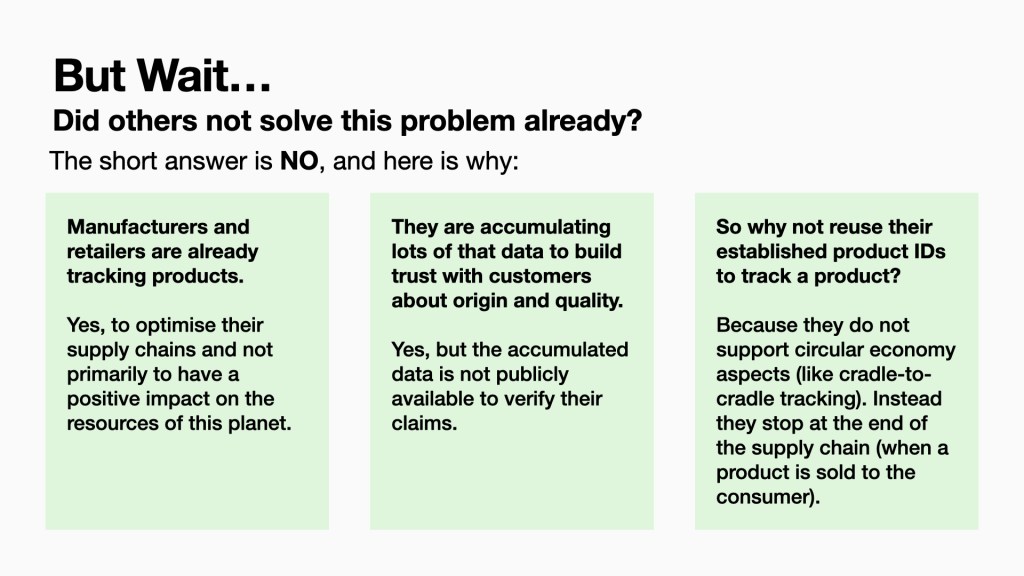
The Difference
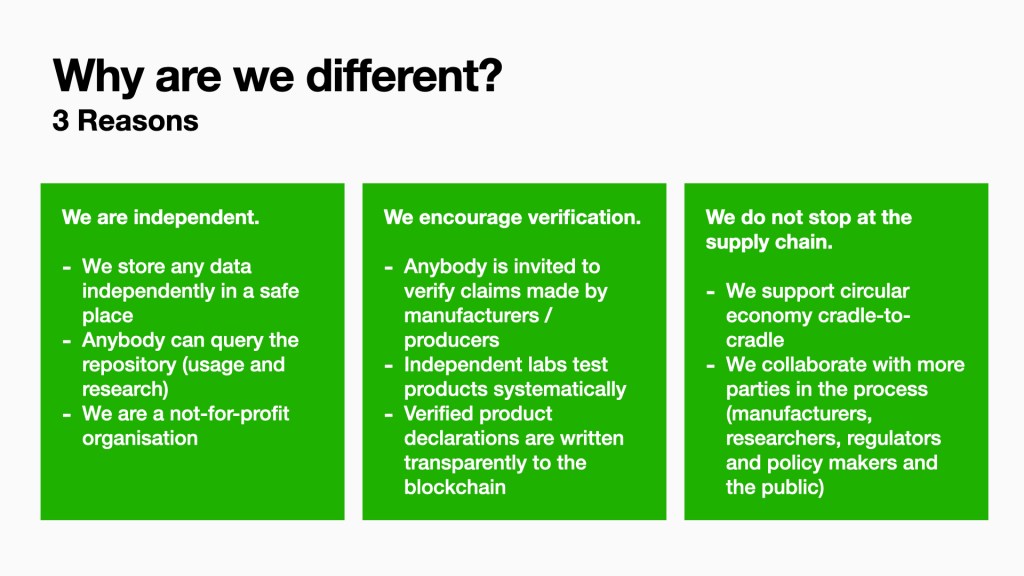
Besides these 3 reasons, we encourage any company and/or individual to join our foundation to bundle our forces and to make concerted effort to improve things for our planet.
Solution Sketch
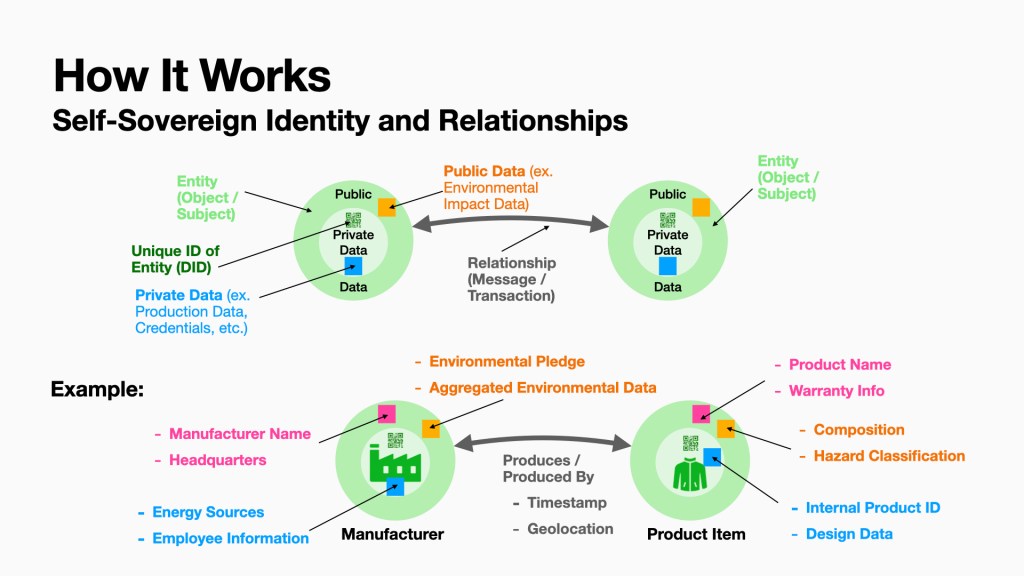
The above solution sketch highlights the basic aspects of the envisioned solution:
- Each entity (product or subject) is identifiable by a unique ID (represented in the sketch with a QR-code). This code is searchable. By scanning the QR-code jumping to a individual public product/subject page is possible. A subject can be an individual, an organization or a geographic entity/location.
- Each entity is associated with a public and/or private set of data attributes. A public data set would be environmental impact data. Readable by anybody. A private data set could be production information private to the manufacturer of the product.
- Each entity can be connected to other entities through one or more relationships. Relationships can be aggregating. In this case data (for example environmental impact data) could be aggregated along this relationship). For example environmental data could be aggregated at the individual, production facility, manufacturer, city, region, country and global level.
On top of these simple building blocks more involved applications can be built.
A first and most important application of this base technology comes in providing health and ecological impact scoring per product (item):
- For food products we provide, based on the foods ingredients, the corresponding Nutriscore.
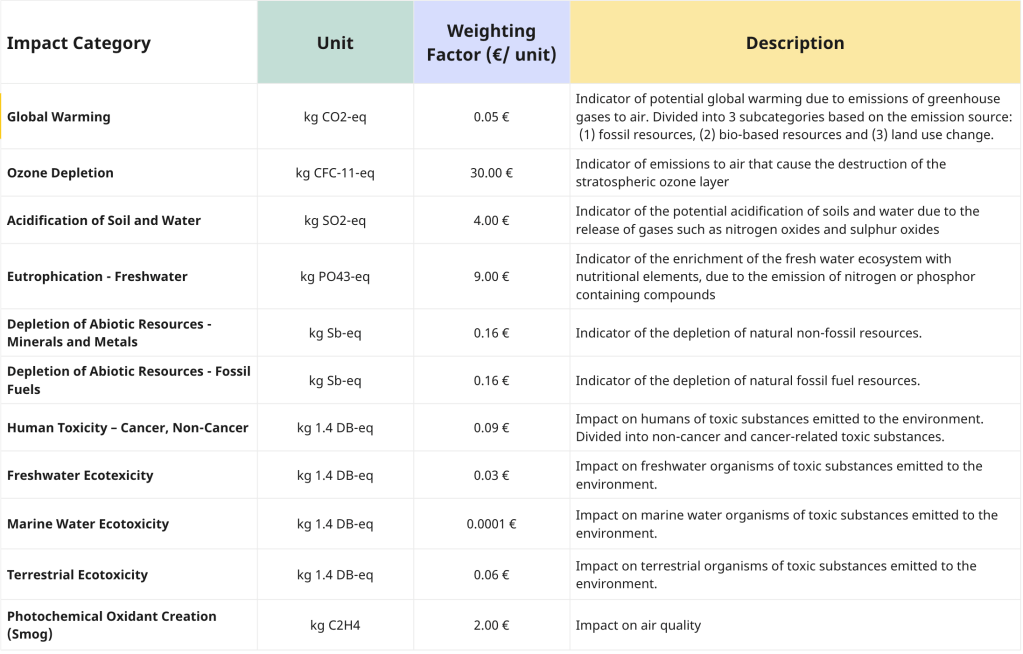
- For all products we want to provide an ecological impact score (EcoStep Score) based on the ecological impact of the product (materials, production process, packaging and in the long run lifecycle). We use the Ecological Cost Indicator (ECI)1 as a way to measure the impact.
The table below shows the impact categories at ECI is made up of.
Talk to us, if you want to know more or to collaborate.
- For more details on the ECI see:
https://ecochain.com/blog/environmental-cost-indicator-eci/ ↩︎
 EcoStep Foundation